A Blue Crumbles Christmas

The Pandora station is set to Let It Snow, online gift sales have skyrocketed and Hershey’s kisses in red and green are flying off the shelves. Finals weeks is in full swing and stress levels are high. Starbucks’ gingerbread lattes are back, the boys next door are sitting around a fire wearing Santa hats and my calendar is on its very last page. Christmas time is here. 
On Thursday, members of the Bucknell Dance Company went to a local senior citizen home to perform for some of the residents.  We arrived a little before 2pm and the room had already been prepared, an amphitheatre of wheelchairs and Velcro sneakers. I pushed play on the CD player and the dancers began. This is what the holidays are about, I thought as feet jumped and bodies spun in time to the music, sharing our joy with others. At the end of the performance, we passed around small cards with pictures of snowmen or candy canes, the words Happy Holidays scribbled in blue pen. It was a small gesture to be sure but I couldn’t think of a better way to spent two hours on a bright crisp December afternoon.
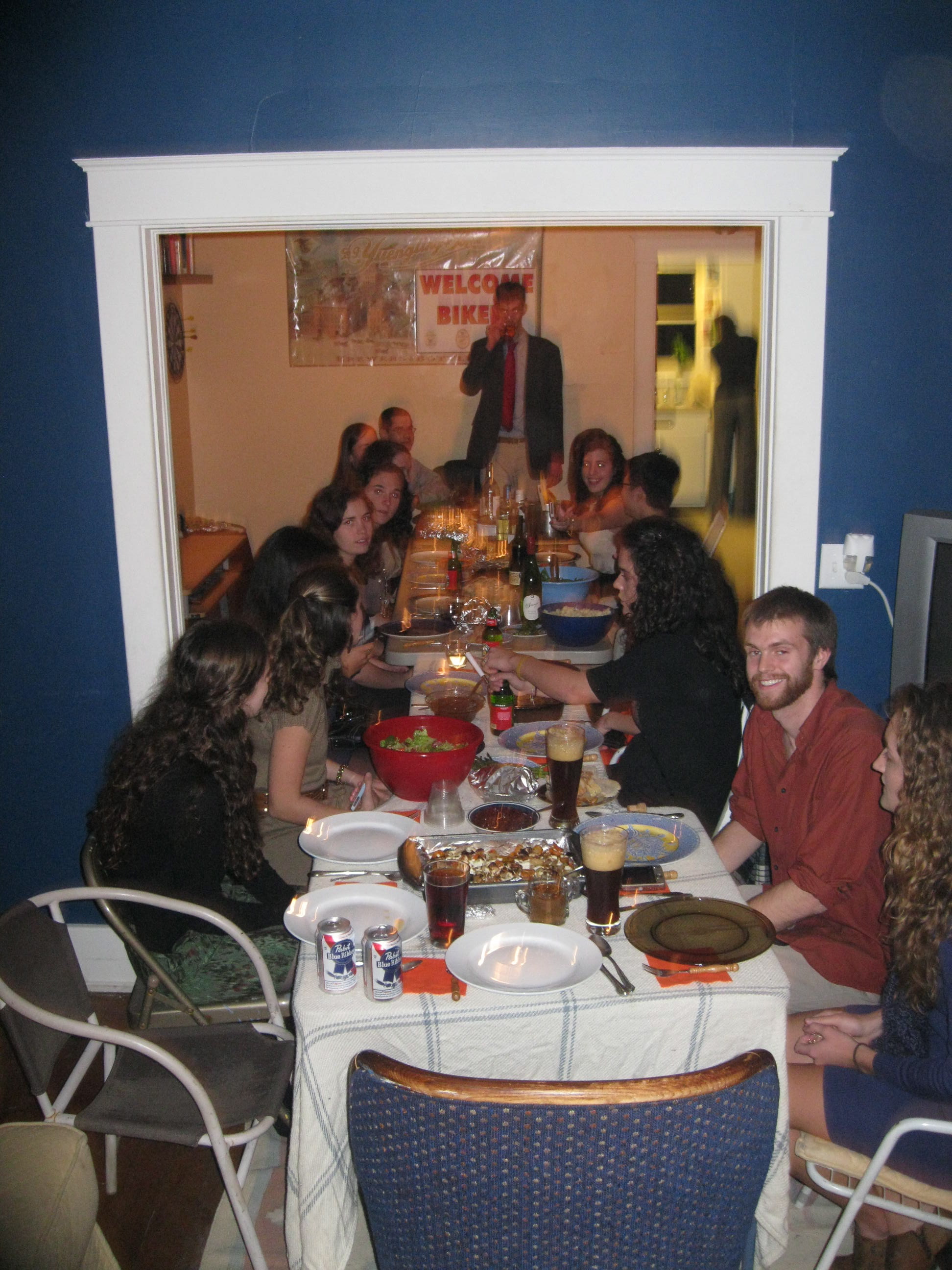
 Late last month, my friends from freshmen year created our very own pre-Thanksgiving dinner to celebrate friendship and attempt recipes our moms had painstakingly explained over the phone. There were logistical issues–foldout tables, number of chairs, size of the turkey–but by 6pm, the food had arrived and everyone had a place at the table. Plates were filled with turkey, salad, mashed potatoes, green beans, sweet potato casserole, fresh-baked bread, roasted vegetables, cheesy potatoes, pies, cupcakes and wine. We gave thanks to long-lasting relationships and great food while asserting our independence. All too soon we would be conducting our own orchestras, harmonizing the casseroles dishes with the turkey pan and number of placements required for a Thanksgiving meal. It was a glorified game of playing house and by the end of the meal, the men were going back for second helpings of pie while the women took to the kitchen, complaining about the lack of counter space and missing Tupperware lids. 

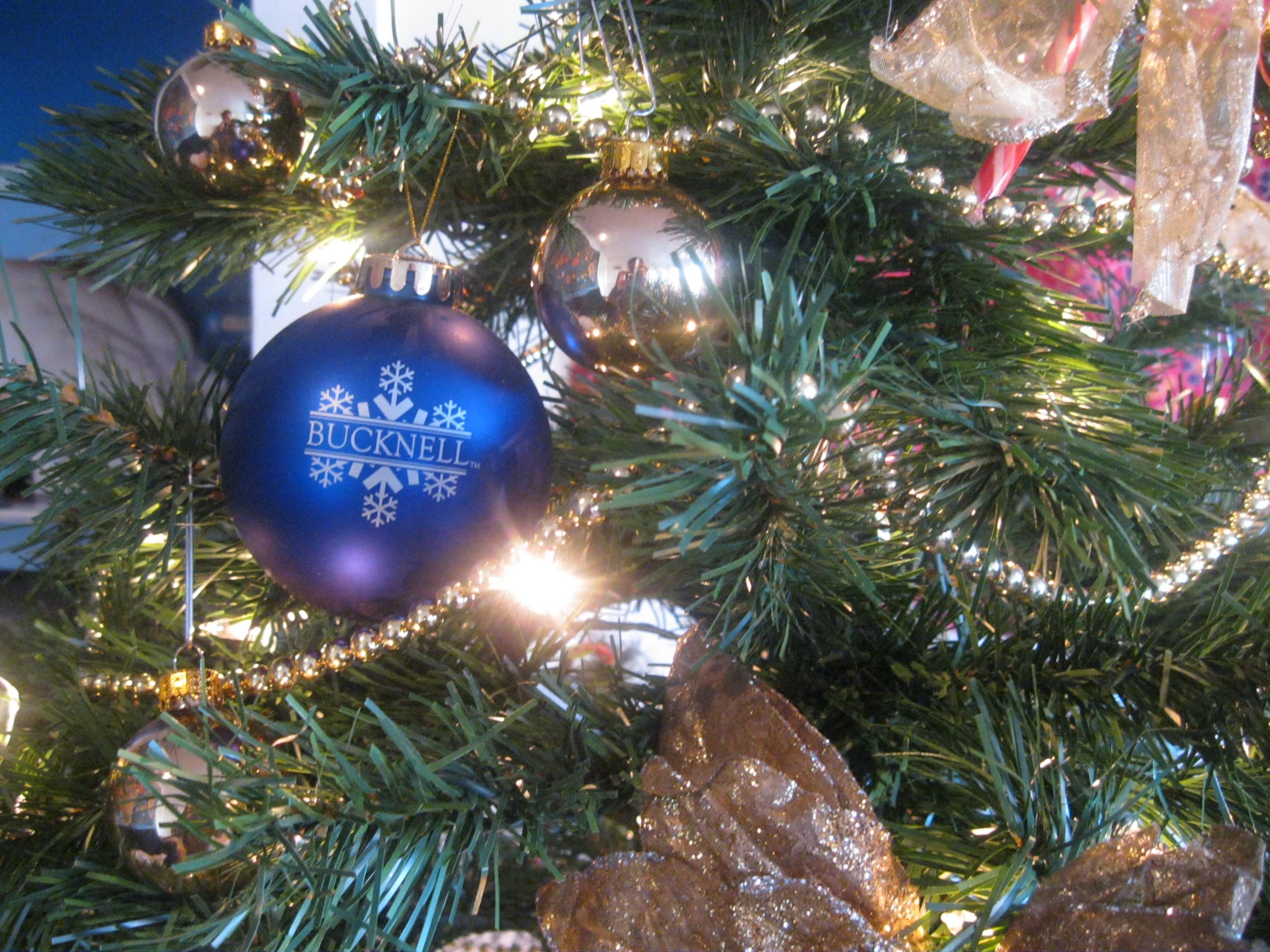
Our house, fondly named Blue Crumbles for its historically weak building foundation, recently geared up for the holiday season. Tonight we will be hosting A Blue Crumbles Christmas complete with festive chocolates, cheese dip and my mulled wine recipe from Denmark. The tree is decorated, the lights are up and the stockings are hung with care. Although none of us can believe the fall semester of our senior year will be over in a few short days, we are celebrating in the only way we know how. Hot chocolate, friends and a little bit of peppermint schnapps.

My life is still very much that of a college student. I attend class, do homework and see friends without the added worries about a mortgage, enough vacation time or reconnecting to loved ones. No matter how many people get accepted to graduate school, get job offers or finish Teach For America placement tests, the words grown-up and mature remain distant spots in the horizon. But these are not fixed destinations for we are always growing and maturing, experiencing new “firsts” and meeting new people. The holiday season is the chance to examine the beauty in your life in the same way one examines a snowglobe amidst flakes of white.

But for now, let’s be thankful for good food, great friends and families who love us. While fear of the future– fear of the unknown–will never completely subside, we should all snuggle up with a blanket and a cup of hot chocolate knowing the figurings in the swirling white snow are just where they belong.

Happy Holidays. 

Implications of 7 Billion People

Some girls grow up their whole lives wanting to be mothers. They carry dolls, babysit for the neighbors, and squeal as soon as a newborn arrives for family gatherings in a decidedly adorable wintertime outfit. While I never put myself in this category the prospect of a family and children in the distant future was definitely appealing. It seems only natural to want children, little bundles of our own genetic makeup who will grow into unique individuals. The essence of ourselves lodged securely in tissue, muscle and identity of another.

And apparently I’m not alone in this sentiment. According to BBC, Huffington Post, and National Geographic, the current world population has reached seven billion peopleCNN has tried to quantify this number in terms that we can wrap our minds around:

  • If you took 7 billion steps along the Earth’s equator — at 2 feet per step — you could walk around the world at least 106 times.
  • Seven billion ants, at an average size of 3 milligrams each, would weigh at least 23 tons (46,297 pounds).
  • Suppose an average thimble holds 2 milliliters of water. Seven billion of those thimbles would fill at least five Olympic-sized swimming pools.

Some scientists report that the UN prediction is premature and the population will not reach the seven billion part until 2012 or 2013. The evidence that this number will be reached however, is fairly absolute.  In the last 21 years the world population have increased by almost two billion people and the number is not expected to decrease any time soon.

Frances Lappé in World Hunger examines the myths associated with global hunger. She argues that overpopulation is not directly correlated with hunger and instead attributes perceived food shortage to prevalence of inequality in resource distribution and land use. Much of the population growth occurs in economically developing countries where large families are investments in labor and productivity as a means to survive.

So what does that mean for my ten or twenty year plan? Will I feel the effects of 7,000,000 people eating, breathing, building, consuming around me? Do I have an obligation to the prosperity of future generations not to have children? 


Arguably, the world population estimates should not determine whether or not I decide to have a child and start a family. But it raises the larger questions dealing with the relationship between individual contribution and the global community. As an America, my ecological footprint is significantly higher than many people in Africa and South East Asia. I wonder how the birth of one child in a developed country compares to a child born in Ethiopia or Bangladesh. The world population statistics are still broken up into population by country, by socioeconomic class, by gender and by race. Our global society will not curtail this exponential population increase until all groups of people are viewed as a collective body of human beings. Seven billion people is still nothing more than a series of ones. One species. One planet. One hope. 

For more facts and information, check out:

BBC World News has a special segment on the upcoming seven billion population deadline. According to the What’s Your Number? survey, I was the 5,289,349,311th person to be born on earth.

Grist posted a Science video titled “7 billion in 7 minutes.” Click here.

BPIP Poster

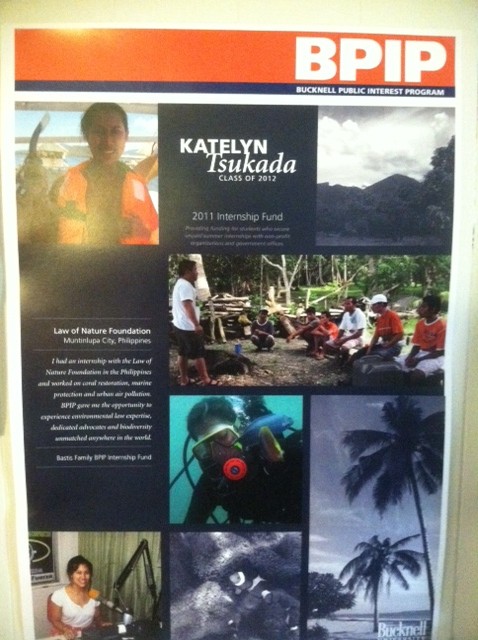
This past summer I received funding for my Philippines internship through the Bucknell Public Interest Fund or BPIP. The fund provides a stipend of $2,500 for students who secure an unpaid internship with a non-profit organization or government. The program was originally based on similar funds at other universities and provides students with the means to partake in valuable internship opportunities that lack financial compensation.


On October 22, there was a BPIP Breakfast held where all recipients and donors were invited to attend. I saw a number of posters detailing other incredible internship experiences of students who had worked with children diagnosed with cancer, taught English in India, or raised money for a girls school in Africa. Here is my poster!

Thinking back on my last three year at college, Bucknell has provided me with the resources to experience amazing things. I wouldn’t have been able to live in Washington, D.C. and work with the Environmental Law Institute or travel across the Philippines working with environmental initiatives if the BPIP fund did not exist. Last fall, I studied for an entire semester in Denmark and this spring break I will be going to the Dominican Republic with a Bucknell service group called A.C.E.S.  And these accomplishment are not unlike many Bucknell students. So many of my friends have taken advantage of even more opportunities to broaden their horizons and positively change people’s lives.

Yesterday, as I donated to the Senior Gift Drive, I thought about the personal growth I had experience since my time at college. I thought about the clubs I joined, the classes I took and the friends I made. The future is uncertain and my 5-year plan is foggy as a November morning. But I value every part of my “liberal arts education” for shaping the person I am today.

Oh, and you can read my BPIP Spotlight here!

Happy Vegetarian Month!!

It’s October and you know what that means… Vegetarian month! So put down your pork chop and bite into a huge juicy black bean burger (made by Morning Star).

Vegetarians get a bad rap. They are often perceived as self-righteous animal lovers, pale undernourished hipsters, or hairy peace-loving hippies. Luke McGee, a blogger for the Huffington Post UK, wrote, “At our worst [vegetarians] are self righteous, self satisfied, judgemental and often extremely rude.” Meat eaters find themselves uncomfortable eating a juicy burger or thick steak after someone at the table has announced they don’t eat meat. Knowledge that a vegetarian has RSVP-ed to a dinner party puts added stress on the host. “Will there be enough vegetarian options?” and  “What is a vegetarian options?” or “Who invited her anyway?” are common questions.

I will admit that I didn’t want to be labeled as one of the aforementioned groups. I had no desire of forcing my friends and family to question the meat on their plate or feel nervous when asking me out to dinner. I had eaten meat my whole life and wasn’t sure I could give up my favorite dishes and flavors for tofu and lettuce. I would try, for days at a time, to eat meatless options before resorting back to a turkey club or roasted chicken. I simultaneously judged and envied my friends who had made the veggie switch. I was impressed with their determination but was skeptical of their reasoning behind the change.

Getting back from the Philippines was the turning point. I had eaten pork dish after pork dish and something inside of me just said, I’m over it. And so my vegetarian life began. Instead of climbing to the tallest mountain top and declaring my rejection of animal flesh, I started off my vegetarian switch without much conscious effort. I didn’t stress myself out about the possibility of failing or setting up a strict diet plan. I just stopped eating meat and days quickly turned into weeks. As an avid foodie, I believed the change would be much more difficult than it’s turned out to be. Sure I eat PB&J more often and learned the hard way how not to refrigerate tofu, but the transition has been surprisingly satisfying. 

Now for the million dollar question:

“Why?”

Sometimes this question is asked with genuine curiosity and other times it’s a judgement, thinly veiled by feigned interest. For me, it’s not about intrinsic animal rights. I think humans are built for eating animals. Animal rights on an individual level is a different story. I got sick of hearing about the diseases, living conditions, and necessary chemicals used in the food industry  (Remember Sinclair’s The Jungle?) without questioning modern-day food production. By buying chicken, beef or pork at the grocery store I was supporting a wasteful and environmentally unsustainable process the world cannot afford. And neither could I. (Below: vegetarian ravioli from vegalicious.org)

My mom has recently become a vegetarian and my dad eats substantially less meat than he used to. My house drinks only soy milk and eats cage free eggs. I’ve started to notice more of my friends who are vegetarians and we find a closer bond through our mutually exclusive diet. Will I be a vegetarian forever? I don’t know. Nor do I suggest everyone should put the breast meat down in exchange for some tempah or beans. I just think everyone should take a second to look at the food on their plate and think about its origin. Where it came from. What it came from. When it was produced. How sustainable the process was. For me, these questions led me to a meatless option so next time I cook a meal I can say beyond reasonable doubt that

no animals were harmed in the making of this dish. 

Remembering Steve Jobs

The cursor blinks on a blank Word document, in hungry anticipation of letters and punctuation to spill out of my fingertips. My midterm essay is not going to write itself. I check my phone for missed text messages and open my music player to my weekly song favorite from Adele. Time to get moving. I open an old essay on the Chesapeake Bay to remember the context of environmental policy debate.

But wait. How is it possible that I can sit here in 7th Street cafe typing on my computer, checking my phone, listening to music, and opening old documents? My technological devices are possible because of Steve Jobs and his innovations that have changed the world we know today. My Apple timeline:

2005-First Apple product: the iPod Mini. Light blue, 8G and super cool.

2006- First Apple computer: my MacBook, given as a gift for my 16th birthday. Love at first sight. The entire computer was located within the monitor and I spent hours exploring Garageband and iMovie.

2007- I bought an iPod Nano with Christmas money. Dark purple and slim.

2008- The college essentials: a MacBook Pro and free iTouch.

2010-Computer stolen in Denmark. New MacBook Pro. Prettier than before.

2011-First iPhone. Downloaded more than 25 apps in the first day.

-Got iPhone stolen out of my hand while walking in Washington, D.C. (see blog). Replacement iPhone sent to my house.

-My grandfather receives first Apple product as main form of Internet connection: the iPad.

So I’ve been surrounded by Apple products for the last six years. Apple is woven into our vernacular (when is the last time someone called a music device an mp3 player?) and remains at the top of companies creating cutting-edge, sleek and user-friendly products.

The Apple website has a small poignant statement:

His name in various forms of hashtags is flooding Twitter with #SteveJobs, #SteveJobslegacy, #Apple, #iSad etc. His numerous quotes about pursuing a job and life you love has been reposted again and again. In his commencement speech at Standard University in 2005, Jobs said:

Your time is limited, so don’t waste it living someone else’s life. Don’t be trapped by dogma — which is living with the results of other people’s thinking. Don’t let the noise of others’ opinions drown out your own inner voice. And most important, have the courage to follow your heart and intuition. They somehow already know what you truly want to become. Everything else is secondary.”

Before, I was terrible with directions, never checked my e-mail, couldn’t listen to music on the go, and didn’t wake up in time for school. Now, with the help of a creative genius, I have an app for that. 

Thank you, Steve Jobs.  

Quick Update

My life as it currently stands (or lays down because it’s getting sleepy):

  • I turned in my thesis proposal on Friday. The current title: USAID Funding and Coastal Resource Management at The Local Level: A Case Comparison between EcoGov 2 and FISH projects in the Philippines. Long-winded with the inclusion of a colon? Check.
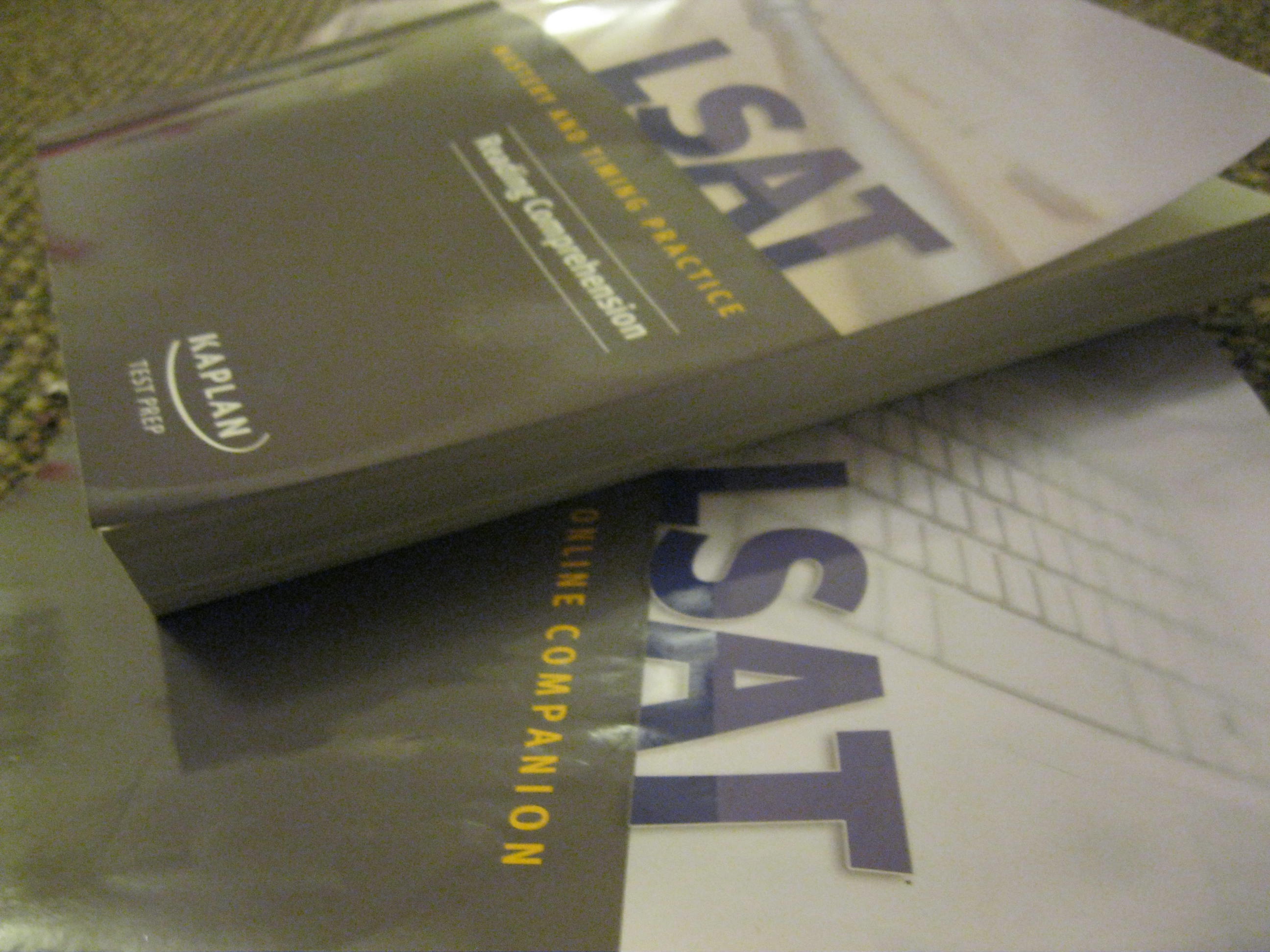
  • I sharpened my pencils, popped a Tic-Tac and took the LSAT on Saturday. Survived a 4.5 hour test without hallucinating little green men were bubbling in the answer sheet for me? Check.
  • I wore my large dark-blue flannel pajamas last night for the first time while grudgingly accepting the fall weather. Imagining cute fall sweater outfit combinations for the next five months? Check.

Checklist complete and homework (partially) finished, I think it’s time for bed.

“And Katelyn was nestled all snug in her bed, While visions of logic games disappeared from her head.”

Laws of Life

A long table sits in the center of a room. Chairs are set up on either side, separated by small name tags that make a white dotted line down the center. On one side, 16 distinguished lawyers are seated with relaxed expressions, each with a small Dasani bottle sweating beads on condensation onto the table top. They are volunteers, men and women who have traveled from their respective hometowns to give advice regarding a career in law. We, anxious undergraduate students, sit across the table and contemplate the years of schooling and experience that span the carpet separating our chair legs and theirs. These professionals see reflections of their former youth in confident juniors and seniors biting at the bit for the chance to prove they have what it takes to be an “Attorney at Law.”

Speed Mentoring, 3-minute conversations with lawyers in a variety of fields, was a great idea. My university thought it would be helpful for pre-law students to have personal interactions with people who might be hiring in the next 4 years, people who had gone to law school and lived to tell the tale. I got a variety of advice:

1. Study for the LSATs. Get into the best law school you can.

2. It is an extremely competitive job market now, compared to when I graduated. Know what kind of law you want to practice.

3. “Well I was between graduate school and law school. Then Harvard Law called me and told me I had been accepted. You don’t turn down Harvard Law.”

I left the event feeling a little shaken. My reasons for wanting to attend law school, I found, were vastly different from a number of lawyers and students I had spoken to. Environmental law doesn’t make a lot of money, isn’t about large corporate firms or Tier 1 networking. There is no glamor, no high-profile grove of trees or celebrity Superfund site. But then again, I realized I didn’t know what environmental law really was or if it would be something I could do. I need a stable job, sufficient income, and comfortable bed just like anyone else. Reconciling the needs of daily life with a young person’s desire to “make a difference” is difficult to do.

And the LSAT, my Charlie and the Chocolate Factory’s golden ticket to law school, is a dull bronze at best. What is it about standardized tests that makes a person question everything he or she previously believed about intelligence and future success?

I tell myself I’m improving. I say I am capable of anything. And yet the practice tests and bubble sheets layered deep within my brain convolutions have begun to seep black tendrils of doubt deep into my logical core. The  forecast of failure is hard to erase. Comparing my brain capacity, summed up in a three digit score, to thousands of other students in the country ripping their hair out over that third logic game or last logical reasoning section isn’t particularly appealing either. Should I stop looking toward the 90% percentile as a hopeful future and string a hammock between the lower half of the percentile curve instead? That I cannot answer. All I know is that I want to do well because  I expect that for myself. Because I’m terrified a bad grade somehow translates to bad person. Irrational but honest.

My godmother sent me an e-mail this week, detailing her similar studying experience regarding an online update for her family practice boards. I can say with absolute certainty that she is one of the most intelligent people I know, with a memory perfectly designed for medicine and standardized tests. She wrote, “the questions are ambiguous, the references don’t provide the answers to the questions, the site doesn’t work well and last but not least, IT MAKES ME FEEL STUPID.” She asked if this was similar to my LSAT preparation and voiced her sympathy.

And that’s the fear: realizing you aren’t as intelligent as you thought after all. The feeling of smallness.

And so I’ve realized that I do not fear the LSAT on October 1st, nor do I fear the work associated with law school or bar certification. I fear that rejection somehow reflects who I am as a person, measuring how much or how little I will accomplish in my life. But rejection, any rejection, does not define me. My self-worth is nothing a test, a law school or a job offer, can take from me. And who doesn’t struggle now and then with the feeling your contribution is just a raindrop in the universal ocean of human kind?

That is the Question?

As children, we question everything. “Why is the sky blue?” “What’s in this soup?” “Where do dead things go?” It is our way of examining the world with our tiny magnifying glasses of innocence and wonder. To me, asking questions was an effortless and necessary part of figuring out people, objects, and my pet cat Charlie to which I was allergic.

In high school, we would get extra points for having questions whenever a guest speaker came to talk. Before the first sentence was uttered, hands would be raised flapping in the air like birds in flight. The answers were never important. The fact that we had come up with a question was satisfaction enough.

Questions in college got harder to ask and even harder to answer. The questions required thought and the answers were less available in their purest form, reduced to scratched prisms that twisted and bended beams of thought. I started to learn the power of the question, of a question, in how one lives life and values the opinions of others. I wanted to ask a big question, an important question. And this desire to find one large, expansive question lead me to my decision to write a senior thesis.

At the end of my junior year, my thesis question seemed far away and full of possibility. I could research whatever interested me, searching for answers to the question I posed. But that question is no longer a mirage in the distance. Yesterday, my thesis advisor informed me that I had a lot of great ideas about the Philippines, its social structure, and internationally funded environmental protection projects. My adventures over the summer would definitely come in handy over the next 7 months when I would begin to wrestle with the available data. But right now what I needed most of all…was a question. A simple request at the surface, but coming up with just one question proved harder than I could have imagined. And I am struggling…

My grandfather sent me a gift last week, tucked inside one of his homemake cardboard boxes. The small wooden carving about two inches high had come alone. No note, no explanation. But isn’t that the way of questions?  They often appear quite out of the blue, just to make sure you’re paying attention.


iPhone is now hisPhone

About an hour after my last post, I was walking back to my friend’s apartment in Dupont Circle looking for directions on my iPhone. I was still getting used to all the features of a smart phone after using my small Nokia for the last 3 months in the Philippines. I had forgotten that phones had cameras, boasted color screens, and needed to be charged more than once a week. The whole world was at my fingertips and I was submerged again into maps, picture-taking, and uploading new apps just because they were free. Technology had sucked me away from my tangible surroundings into a LinkedIn library complete with Facebook and Twitter. (Read  Tech Crazed by my college roommate for a further discussion on our technological dependence.)

And so, I had my attention so closely focused on my iPhone that I didn’t hear anyone come up behind me. Before I knew what had happened, a young black male had taken my beloved touch-screen friend out of my hand and ran until he disappeared down the street. I screamed after him and even tried running, but my large purse and flip-flips were no match for his sneakers and nerves. It was hopeless.

It struck me that I had spent a total of 11 weeks in a country known for kidnapping, murders, Muslim rebel groups, and prostitutions rings just to have my phone stolen 2 days after returning to the US. As a traveler, I had let my guard down as soon as I stepped foot off the plane at JFK. I felt safe in my country, walking among trusted Americans. But even here, the pursuit of happiness is difficult for many. What kind of life did this young man lead, causing him to steal from others? I do not think the thief felt my pain, did not pity my sense of loss or isolation. I had more than he did: more money, more opportunity, more possibility. I would feel upset, buy a replacement phone and move on. What would he do? Sell the phone for a couple bucks before worrying again how to make some quick cash again. I did not envy the path he took that eventually led to our brief encounter. Even with my phone, his life would continue to be much harder than mine.

And while that young man will never read this blog, nor meet me again I hope that my phone gives him some joy, helps him in some small way to get out of his current situation. However, I also want him to look back and feel regret for his petty crime, feel the need to repay that debt by performing good deeds to strangers instead of ill will. The world has too much hate and suffering already. It does not need any more.

My replacement phone should come tomorrow and I would love texts/messages/e-mails/calls/tweets welcoming me back into the addicting world of technology. Until then, the buzz and ring associated with instant communication is replaced with the sound of the rain falling against the leaves outside my window.

H.R. 2584

“H.R. 2584, with its deep cuts in important environmental and natural resource programs and amazing array of special interest riders and funding limitations, falls far short of meeting our responsibilities to protect and wisely use the resources of the earth.”

-Congressman Jim Moran, 8th District of Virginia

I am a proud American whether I’m home in New York, at school in Pennsylvania or traveling in the Philippines. When I read about a new bill bound for the House of Representatives, I was shocked and upset. H.R. 2584 is an appropriations bill “for the Department of the Interior, environment, and related agencies for the fiscal year ending September 30, 2012, and for other purposes.”1

The bill will prevent the Endangered Species Act from adding any new species to the list. It will remove funding for and protection of grey wolves and big horn sheep. Furthermore, the bill prevents the EPA from using funding to ” modify, cancel, or suspend the registration of a pesticide… in response to a final biological opinion or other written statement” about the harmful effects of the pesticide on an endangered species or its surrounding habitat. It will open up one millions arces around the Grand Canyon for mining!

But maybe animals aren’t very important. What about humans? The bill also adds a number of riders that would actually increase environmental health hazards for American citizens. The EPA’s current proposed Mercury and Air Toxins for power plants will be further delayed. The EPA’s appropriated funds cannot be used to increase water quality in Florida or modify the current ambient air quality standard, directly affecting public health. Our health. Cleaning up a river filled with toxins or dealing with sickness caused from air pollution is much more costly than monitoring and regulating the pollution in the first place. The pre-cautionary principle not only saves money but saves lives. And most of these riders do not even reduce the overall budget.

John Walke, in his commentary as a NRDC staff, writes, “Among other things, the Lummis amendment would weaken the Clean Air Act by blocking forthcoming protections to sharply cut mercury and toxic air pollution like arsenic and lead from power plants that burn coal and oil.”2

Congresmen Jim Moran’s press release voiced his frustrations with the bill as Ranking Member on the House Interior and Environment Appropriations Subcommittee. “The list of legislative riders and funding limitations in the bill is long: NEPA waivers, limitations on judicial review, and the blocking of pollution controls. Whole legislative texts have been dumped into this bill. These riders and limitations have nothing to do with deficit reduction and everything to do with carrying out an extreme ideological agenda.”3


The United States of America needs to lead to fight against environmental hazards that threaten our fellow humans and the natural world. When will the US realize large-scale mining, lax air pollution regulations, and destruction of biodiversity are things of the past? Say NO to H.R. 2584.

Additional Links:

Read the full text here or here.

Click here to send a letter to your representatives or call directly with instructions from American Bird Conservancy.

Read Top 10 American Vacation Spots the House’s Environment Spending Bill Could Ruin